Alex Stark / Celestial bodies
Updated: Aug 11
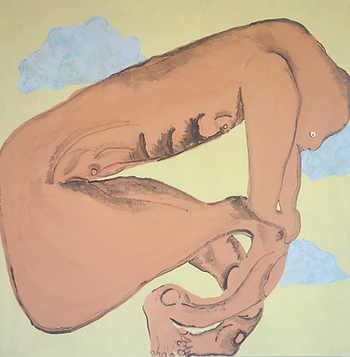
It seems curious that the work of renowned gay British mid-20th-century artist Francis Bacon, known for his idiosyncratic painterly abstractions of the human form, isn’t widely associated with disability. It’s true that Bacon, though being both asthmatic and an alcoholic, didn’t explicitly represent disabled bodies. And yet, his organically rendered and dynamically textured figures and portraits, their blurred energy often starkly counterposed against geometric shapes and flat areas of color, depict something far from an ableist anatomical ideal. In his book on Bacon, the philosopher Gilles Deleuze cites the artist as saying that “the form related to the sensation (the Figure) is the opposite of the form related to an object that it is supposed to represent (figuration)”; Deleuze then cites the poet Valéry saying that “sensation is that which is transmitted directly, and avoids the detour and boredom of conveying a story.” Continuing this distinction, Deleuze states that Bacon’s “Figures are lifted up, doubled over, or contorted, freed from all figuration.” “An intense movement flows through the whole body,” writes Deleuze, “a deformed and deforming movement that at every moment transfers the real image onto the body in order to constitute the Figure.”

Bacon’s tendencies to eschew representation, to avoid narrative and interactive space, and to create energetic sensation through color, as well as to work in diptychs and triptychs, in symmetry and doubling, all appear in the figurative work of queer disabled painter and ceramicist Alex Stark. Rather than Bacon, Stark cites influence from spontaneous, colorful, and avowedly primitivist works like those by artists in the European CoBrA movement, also from the midcentury, with which Stark’s work has more stylistic parallels. But the ecstatic nude figures in Stark’s paintings and sculptures suggest intuitive identification with a body in motion more than immersion in an environment, despite the strange and lush settings in many paintings. “Some of (the poses in my work) are things that I would do with my own body,” Stark told me, “because I would see myself moving.” At the same time, he said, “I think about how people interact with my work, too, and with my paintings, how they might see it… I think it could be seen a lot of different ways.” But ultimately, “I don’t particularly care how people see it.” Crackling and shimmering with variations in hue and texture, Stark’s bodies encounter their idyllic mythical surroundings with a joyful force that pushes against the frame, recalling the shapes which Bacon uses to barely contain his swirling figures.

In another similarity to Bacon, Stark sometimes depicts poses that evoke crucifixion, as well as seated figures that might suggest a contemplative Buddha. Animals also appear at times in both artists’ works. Bacon’s apes, dogs, bulls, and owls carry an air of menacing ferocity, however, while the majestic birds that Stark interposes with his ethereal human figures connote the freedom and power of the spirit, as well as (literally) vibrant connections between living beings. “This is not an arrangement of man and beast, nor a resemblance;” as Deleuze said of Bacon, “it is a deep identity, a zone of indiscernibility more profound than any sentimental identification(.)” The profound spiritual valence of Stark’s paintings was brought to the fore in After the Flood, his solo show this summer at Epiphany Art Center in Chicago, in which his work was shown on dark blue walls and accompanied by chandeliers and stained-glass windows. “I’m not a religious person,” Stark told me, “but I do feel like there is some kind of connection of worship that I feel towards the figures. They’re kind of almost deity-type figures, or versions of myself.”

For both artists, the spiritual is inseparable from the corporeal. Again citing Deleuze on Bacon, “Meat is the common zone of man and the beast, their zone of indiscernibility.” But while Bacon’s crucifixions often explicitly referenced butchered cadavers, Stark’s bodies, though often permeable and translucent, even ephemeral, are fully alive: “the inside outside of the body,” as he put it. Particularly palpable in the shiny swirling marbled glazes of his ceramic pieces, Stark says, “I can see muscles and veins and wrinkles and fat in the surfaces.” The mystical perceptual attributes that these pieces conjure also reflects Stark’s visual disability, which is one of the sites of nerve damage he lives with as a result of childhood brain cancer. His doubling of figures, and the diptychs and triptychs he creates, are an expression of his experience of seeing double. Lacking conventional depth perception, Stark uses color to create space. And the partial paralysis he experiences on his right side directly affects the marks he makes and how he shapes clay, resulting in the energy and vulnerability that unite and animate his images and forms.

In the work shown at Epiphany Art Center this visual fluidity takes the form of collage, in which the vivid activity of paint melts seamlessly into photographs of fruit, plants, rocks, crystals, fabric, water, and geometric patterns, as well as the occasional youthful male body. These details add visual associations that are not only sensory but, to a degree, sensual. Though nothing in these works is straightforwardly sexual, even given the unclothed male figures, a teeming vitality is undeniable. In some of this recent work, he says, “there’s a little more of a visceral relationship to food, food that you like, or makes you hungry, or makes you disgusted.” Having introduced this element of tangibility, Stark admits that these works are both more playful and erotic than his earlier pieces, and speculates intriguingly “that that might overlap with disability.” But perhaps the most pronounced effect of the collage elements is to enhance the effects of Stark’s use of paint, much as in Bacon as described by Deleuze: “We see everywhere the reign of the blurry [flou] and the indeterminate, the action of a depth that pulls at the form, a thickness on which shadows play, a dark nuanced texture, effects of compression and elongation.”

As a final note, a significant aspect of Stark’s work is his curation of annual exhibitions of work by remarkable disabled artists at the Design Museum of Chicago, in a series entitled Voices Embodied. Now in its sixth year, the series in its run has featured over 90 artists from the U.S. and abroad, including several profiled here on the Institutional Model blog. Entitled Prognostication, the current iteration is the largest yet, including work by no less than 37 artists. This project makes an incredible ongoing contribution to the visibility of disabled artists, and deserves wide recognition and celebration. Performance and screening events are planned as well. Prognostication is on view until January 18, 2027 in downtown Chicago.


Comments