Panteha Abareshi / Sterility and desire

In his 1917 essay “Mourning and Melancholia”, Sigmund Freud separates melancholia from mourning, or depression from grief, primarily by its interminable duration, in which ambivalence between love and hate for a desired object, cathexis and anticathexis, exhaust the subject in a manner that resembles a “an open wound,” an injury or a sickness that will not heal. Rather than sitting with sadness for a lost relationship, sadness which can gradually dissipate through a process of conscious reflection, the object of desire for the melancholic is internalized and intensified. The result is a concerted attack on the subject’s ego, potentially to a degree that can lead to thoughts of suicide. Freud contends that “the ego debases itself, and rages against itself”, but concludes that he must delay further statements on the relationship of ecstasy (pathologized as mania) and melancholy “until we have gained some insight into the economic nature, first, of physical pain, and then of the mental pain which is analogous to it.”

This complex interplay of mental and physical pain, melancholic exhaustion and ecstatic debasement, form a crackling current that runs through the charged work of artist Panteha Abareshi, work which can be read as an ongoing elaboration of Freud’s ideas about grief. “Grief is heavy,” they told me.
It is deeply rooted. It is not finite in the way that we are essentially taught to understand grief, as point A to point B, you are grieving, and then you're done grieving. And I think that that is the really comfortable notion of grief that we must push against, and say grief is a process that is never-ending… I think that, encapsulating that within my work is a really crucial part of pulling back the curtain on a true representation of an embodied illness, an embodied disability, where it is not simple, it is not easy, it is not for comfortable consumption.
Living with a form of sickle-cell illness which was diagnosed as degenerative in adolescence, they have spent years translating their lifelong medicalized experience of torment and constraint through searing pieces that alternately reference medical graphics, hospital technology, and the artist’s body. Abareshi’s art embodies forms of mourning and melancholy that are defiant, critical, and darkly humorous, but not beholden to narratives of redemption, recovery, or healing. For Abareshi, “Grief is a matter of survival; it is an exercise in perserverance, because, at every turn, there is something in the body to mourn.” This stands in stark contrast to the position of the able-bodied non-sick medical caretaker that can be a relation of intimacy and tenderness, but also of management, avoidance, and silencing. As Abareshi says, “Tenderness is a knife that cuts both ways... There is a violence in care that is often quite inescapable.”
![Prescribed Regimen [Video Iteration & Installation Iteration] (2025) combines ink on pharmaceutical promotional notepad papers with a sound score. Dozens of notepad sheets are arranged in evenly spaced horizontal rows across a white gallery wall. Most are white or pale-colored and display medication branding, including Celebrex, Lescol, Ambien, and Omnicef, alongside short, faintly printed phrases. Bright yellow sheets, a blue page marked with the number five, and several red strawberry-shaped notepads interrupt the otherwise clinical arrangement.](https://static.wixstatic.com/media/8172d4_631609190dfa4bd29b160af60f5ecbe9~mv2.webp/v1/fill/w_980,h_654,al_c,q_85,usm_0.66_1.00_0.01,enc_avif,quality_auto/8172d4_631609190dfa4bd29b160af60f5ecbe9~mv2.webp)
Extending the encounter with what Zakiyyah Iman Jackson refers to as the “irreducibility and opacity” of Blackness, Abareshi proposes that “the able-bodied society at large has an idea of what the disabled body is, has an idea of what the queer body is, and those ideas are so reductive, it's violent.” Representing their experiences not only through objects and images but also through text is central to Abareshi’s practice, a practice which paradoxically dwells within illegibility: the opacity of the Brown queer sick body, as well as of pain itself. For them “it's not about reductive language, but it's rather putting abstract language to the disabled body in a manner that is quite emancipating.” In their objects, videos, and prints, they regularly appropriate the disembodied voice of scientific authority, as well as the palliative conventions of what they identify as a “quotidian… fetishization and infantilization of the body” which is “pathetic and sad and worthy of pity.” But for Abareshi “it is so crucial to resist an essentialization”; for them both the queer body and the disabled body “contain such radical multitudes.”
Abareshi mentioned being asked during a public event to envision a perfectly accessible space, and in their response they insisted that even a totally physically accessible space would still be inaccessible to them as a queer person of color. Opposing fantasies of perfect access through refusal and obfuscation, Abareshi says, “I create barriers of access within my work, both for the able-bodied individual, but also for myself.” An example of this is how they “equip the white body” in their work, deliberately incorporating Caucasian flesh tone medical models into their sculptural asssemblages. Both the medical authority and the non-sick onlooker, they note, are “constantly demanding that the disabled body and the sick body make itself known and legible to the able-bodied individual,” trying to domesticate “the really complicated and quite exhausting navigation of an intersectional existence.”
Seventy years after the publication of “Mourning and Melancholia”, Leo Bersani, a major early figure in queer theory with an interest in Freud, similarly diagnoses both ambivalence and debasement in his influential essay, “Is the Rectum a Grave?” In it he contends that “male homosexual desire,… like all sexual desire, combines and confuses impulses to appropriate and to identify with the object of desire.” At the same time, Bersani goes on to describe how during the U.S. AIDS crisis the displacement of gay male sex as an image of alluring but unbearable feminized debasement allowed mainstream society to express their desire to exterminate queer people. Bersani writes that AIDS “reinforced the heterosexual association of anal sex with a self-annihilation originally and primarily identified with the fantasmatic mystery of an insatiable, unstoppable female sexuality.” In offering enjoyments that debase rather than reinforce the ego, sexuality for Bersani offers ecstatic liberation from political melancholy.

Abareshi has presented their body as a sexualized object throughout their video oeuvre: fetishistically framed and restrained by medical paraphernalia, sometimes passive and at other times in obvious distress. These clips and stills are generally interspersed with bold text and schematic graphics, overlaid by unnerving textures orchestrated from the humming, beeping, pulsing textures of the hospital soundscape. The overall effect is unsettling and alluring, bringing racially-charged erotic fantasies of medical kink into confrontation with Abareshi’s lived and literal reality of corporeal pain and pleasure. These works also channel the history of Black and other colonized women’s bodies serving as nonconsensual spectacles, targets, vessels, tools, and experiments while alive, then dissected and put on public display after death.

Still from video Erogenous Zones of the Sickbed (2025)
This element of Abareshi’s work is evolving, however. “At the beginning of my practice I was throwing myself into my work,” they told me.
My disability is sort of made material, and it actually became too comfortable and too easy to equip myself as material in my work, because it is so immediately evocative… A Brown body putting itself through these really strenuous performative gestures speaks immediately to a sort of strife and a pain, and it was too easy for me to reach to that, and to equip that as a sort of shortcut to the meaning that I was trying to evoke.
Their 2025 installation Examination Room offered a different approach to sexual exploration, exploitation, and extraction in the context of disability. Surrounded by a hospital curtain, one space in the show was an examination room, featuring an exam table and monitors showing a variety of medically-themed pornography, alongside Abareshi’s erotic performance video. Revealed further into the exhibition, the other space was a control room in which Abareshi was physically present, watching visitors in the examination room through surveillance cameras. “It was quite potent in making people confront this idea of their own able-bodied gaze,” they said.
These forms of looking, where they believed that they were sort of having a private moment, and people are so fascinated by the pornography, you know, they're leaning in, they're crouching down to watch it, it's a quite intimate exchange,
In a pyramid diagram they created separately from this piece (scroll down to view), Abareshi schematized erotic depictions made by and featuring sick and disabled people, as opposed to able-bodied people. In both this diagram and the Examination Room installation, dynamics of disavowal that apply to non-sexualized sick and disabled people become profoundly acute and illuminating in the case of erotic disability fetishism.
![Examination [Exam Room & Observation Room] (2025) is an installation composed of two connected clinical environments. This view shows the exam room enclosed by dark teal privacy curtains. A teal examination table with built-in drawers stands on the left, while a wheeled metal cart holding several small video monitors occupies the center. The monitors display close-up footage of a body undergoing examination. A tall, white mobile medical imaging machine stands on the right, partially framed by the surrounding curtains.](https://static.wixstatic.com/media/8172d4_004b4722673b4a1caeb8104114c96337~mv2.webp/v1/fill/w_980,h_654,al_c,q_85,usm_0.66_1.00_0.01,enc_avif,quality_auto/8172d4_004b4722673b4a1caeb8104114c96337~mv2.webp)
Different kinds of disavowal and fetishism apply also to Abareshi’s experiences in and analysis of children’s hospitals. A queer theorist often linked with Bersani, Lee Edelman, is known for the figure of “the Child”, which appears in his 2004 book No Future as an iconic trope ordering heteronormative fantasies of reproductive futurity. The scholar James Bliss has applied Edelman’s analysis to “the incoherence of Black reproduction”, and Abareshi’s intervention brings a similar lens to the case of sick and disabled children, while again interrogating Freud’s temporal notions around mourning. In an online post Abareshi suggests that “the cripple child”, unlike the disabled adult, is “not some lost cause or waste of resources.” Or, as they told me, “The children’s hospital does not treat the child as though they will be sick forever.”
Compared to what they have encountered in adult institutions, their experience in children’s hospitals was completely different in terms of the tone of the interactions, the visual environment, and even the smells they experienced. Doctors and nurses were soothing and apologetic to the young Abareshi, entreating them to look away from needles and concentrate on the cartoon characters that decorated the walls. Despite attempts to cajole and distract, however, Abareshi insisted on being alert and remaining attentive to the medical interventions on their body. They told me:
I developed this deep, unshaking need to watch, to see the needle poke the skin, to see the blood be drawn, to see what was causing me such pain… Being told that I should look away, my instinct was always to resist against that, and I'm actually glad for that, because it would have been so much more jarring to proceed into my degenerative condition as an adult, and have that instinct to look away from pain, and to run away from pain, and to try to be ignorant of my pain.
They describe as “night and day” the difference between this experience and the feeling of being racialized, sexualized, and socioeconomically devalued in adult facilities. Their condition is not temporary, and so it would seem that the efforts made to comfort them were not in fact for them, but rather were for the able-bodied people caring for them. The “Child” they sought to soothe was not Abareshi, just as the non-sick, non-disabled actors and directors in hospital-themed pornography are not largely concerned with the pleasure of actual sick and disabled people.

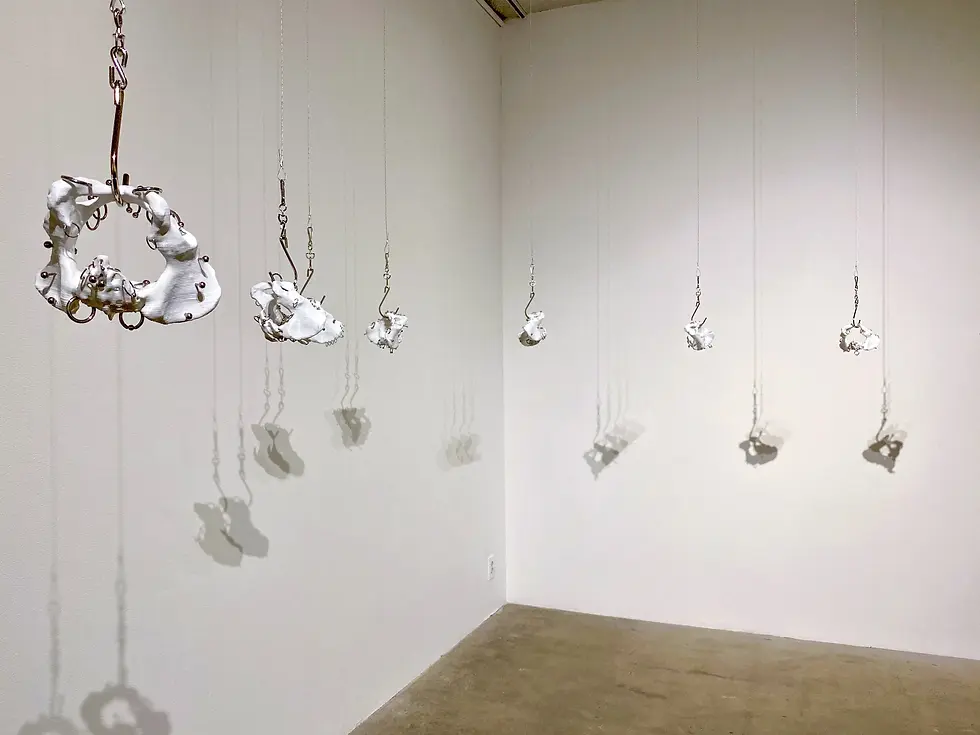
The portion of Abareshi’s artistic output that seems to encapsulate their early experiences is their sculptural work, assemblages of medical ephemera that often include plastic anatomical models, and which emerge from and speak to their experience of making work from their sickbed. The provocative positioning and piercing of mass-produced body parts, customized with text, graphics, jewelry, and other sundry items, communicate the eroticized relation to constraint, contortion, and control that typifies their performance work. But the assemblages’ tidy compositions, bright colors, and modest scale are reminiscent of children’s crafts, toys, or games, while also sometimes evoking miniature shrines, altars, or reliquaries. “While still ostracized and hyper-scrutinized,” Abareshi writes, ”the sick, cripple child is allowed a peace in their suffering, and the children's hospital gushes out gifts, and treasures and play for the sick, crippled child.”

Through subverting the vulnerability that is only tolerated in a child, and transgressing the fetishistic disability kink that is only allowed to an able-bodied sex worker, Abareshi inhabits through their art a space outside of the visible and knowable sick subject, needing and deserving of care. “I'm really fascinated with the phrase, ‘to take care of,’” Abareshi told me, “because it can mean ‘I'll take care of it.’”
It means taking it out behind the barn, like Old Yeller or something. Or it can mean disappearing something, or it can mean enveloping it in tenderness, or it can be quite rote, like a sort of mechanical idea of care… Care does not beget tenderness, always.
Keeping a cautious distance from expressions of care and comfort, Abareshi certainly does not reject the relations with others that sustain their life and their world. But in an ableist society, expressions of care are inseparable from the assignment of stigma. As they assert,
Stigma is really associated with a eugenics model of marking those bodies that do not conform to normative standards, chronicling them, keeping track of them, as a means of an eradicative mindset.
Freud understands melancholia as a form of regressive narcissism, returning to a time of simple identification and gratification, insufficiently attuned to the expectations of others which orient well-adjusted adults toward autonomy and futurity. But this form of sociality relies on sustaining shared fantasies, while being sick, being queer, and being racialized all necessitate, in various ways, standing apart from and disrupting those fantasies. In such circumstances, freedom, ecstasy, and nostalgia need to be creatively fabricated using whatever is within reach.


Comments