Pooja Pittie / Process pieces
- Bert Stabler
- 3 days ago
- 6 min read

Painter and fiber artist Pooja Pittie reflected with me on the natural associations viewers draw from her vibrant abstractions.
I live in a city, I grew up in a city, but also, I don't know what it's like to go on these long hikes, climbing mountains or going camping. I have some memories of doing things like that when I was a kid, but I got diagnosed when I was 22, and I had just moved to the US. So I feel like I didn't really have the opportunity to be in nature, or make time for being in nature. So that's kind of an interesting thing, because people always told me my paintings look like landscapes or seascapes.
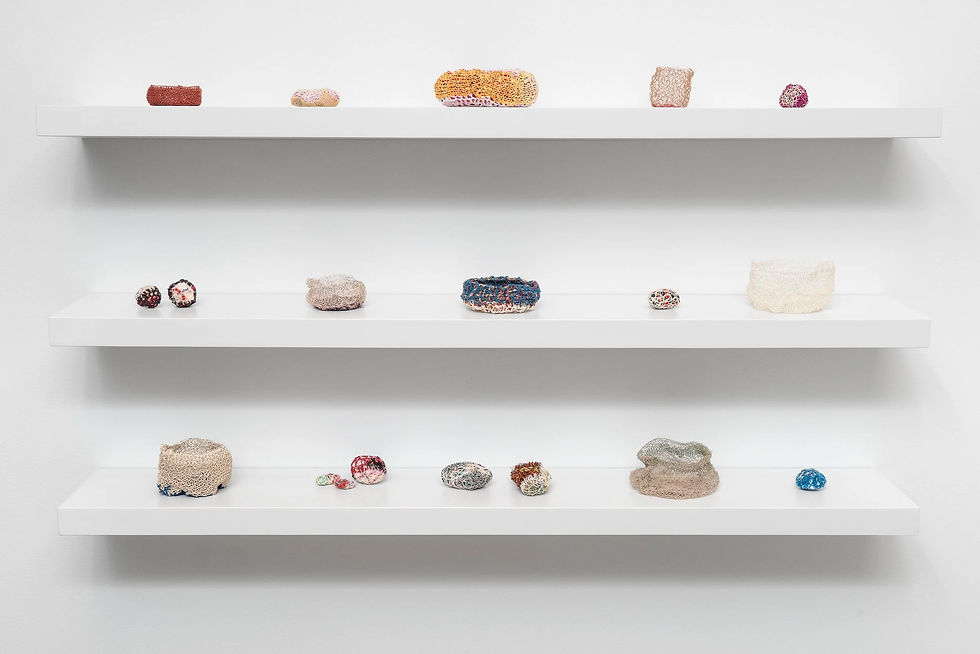
While her layered canvasses evoke the arboreal lattices of Joan Mitchell and Helen Franklenthaler, though with a denser and more fastidious application of paint, her chromatic fiber works break free of both the flatness and the frame, taking the form of organic crocheted vessels and tapestry-style hangings that sprout prolific strands and from which untethered sections dangle like fecund vines of ivy. The feeling in her work of pulsing and fluttering movement over a surface of uneven but patient accretion and evolution persist across her work, all of which can be seen as representing the artist’s own history of myriad paths toward personal flourishing.

Pittie’s life was shaped in early and defining ways by her family’s dedication to business endeavors. Her undergraduate degree is in accountancy, and she came to the U.S. at age 21 for an arranged marriage. She co-founded a successful transcription outsourcing business, but left the business to complete an MBA at the University of Chicago, after which she and her husband divorced. While raising a young child and launching a business creating and selling children’s books and DVDs related to Indian culture, she was also beginning to explore her artistic interests, taking continuing education classes at the School of the Art Institute of Chicago and starting to dabble in oil painting.
During this time she began to feel the increasing limits on her body being imposed by the progressive effects of muscular dystrophy, but still continued to pass as able-bodied. But eventually Pittie started needing to make regular use of mobility aids. 2017 was the year that she both shut down her publishing business and gained representation with McCormick Gallery in Chicago. As a full-time artist, she finally found an outlet in which her assiduous drive toward productivity could find its own direction and pace. Alos around this time, through a residency with 3Arts, she met Margaret Fink from the Disability Cultural Center at the University of Illinois at Chicago. Fink told Pittie about the concept of the “bodymind”, a holistic sense of a living self that is referenced throughout disability studies, and an idea which Pittie found to be quite compatible with her understanding of Ayurvedic medicine.

Pittie’s early artistic exploration began with making complex realistic drawings inspired by images such as the complex crowd scenes created by the self-taught Indian cartoonist Mario Miranda. Reflecting on an adult watercolor class she took at SAIC, she talks about the pushback she got from her instructor when she attempted to create tight renderings over careful pencil sketches.
The instructor was very frustrated with me, and he would keep scolding me. He's like, ‘you're not using watercolors the right way, this is not how you're supposed to use watercolor.’ …He was like, ‘No, no, no, use more water’, he was so frustrated with me. I did not enjoy that class at all… And even now I really like very illustrative detailed paintings. I think also coming from India,, the whole miniature painting, the religious paintings or images that you saw, were very decorative, very ornate and detailed.
Nonetheless, Pittie’s large paintings, which she primarily creates with acrylic on canvas, find a middle ground between the free expression of the medium and the organic yet precise composition of small and large elements to create visual experiences of depth and complexity. While painting, she told me, “I still get lost in this flow state, and my mind feels like what they tell you to achieve during meditation. Like, my mind is completely quiet.”

Pittie began painting her large works in 2015. In years past, she told me, “I would start all these multiple canvases, I would move between them, there were different color palettes, it kept things interesting. And then I would have a week where I would just finish five of them.” Her painting workflow has changed quite a bit since then, however. Her shoulders and neck cause her pain when sitting up and working at an easel, as well as considerable fatigue. Now Pittie works on one painting at a time, while focusing her limited energy and endurance in a more recently developing area of interest and focus. The many shifts in Pittie’s life over the past decade seems to have led her to making work which engage both her mind and body on their own terms, and this has led her now to working in fibers.

Pittie learned sewing as a schoolgirl in India, but she began experimenting in earnest with fiber during the COVID lockdown. It has now become central to her practice. “I work with fiber every day, every single day, for several hours a day”, she shared during her presentation at this year’s Disabled Artist Symposium. Noting that she can work sitting for hours on fiber work with minimal pain and fatigue, she also spoke about
building in layers, which kind of connects to my drawing practice… the threads and the way I knit and crochet, you're stacking line upon line, it really reminds me of how I approach my drawing practice as well.

At the same time, gravity pulls against the horizontality in these fiber works, which softly sag, droop, and dangle across their richly colored and textured surfaces, whether hanging from walls or structures, or stitched together as volumetric objects. And while drips and vertical marks characterize some of her paintings, the fiber pieces truly occupy space, conveying a sense of graceful collapse. “The vessel is very much a metaphor for the body in my practice,” Pittie said during the symposium. “There's no escaping it, that's what it is.”

Along with conjuring the body, Pittie’s fiber practice is allowing her to re-encounter the natural environment. “Fiber also offers me this opportunity to feel more connected to the outside world,” she said during the symposium, “compared to painting, which can be a more solitary practice.” In more directly evoking the world of human and non-human life forms, Pittie, despite her lifelong lack of access to wilderness, finds common ground with two literally monumental abstract fiber sculptors that she mentioned in our interview as sources of inspiration for this current direction in her practice, both of whom passed away about a decade ago.

Polish sculptor Magdalena Abakanowicz began as a painter of growing things, and quickly began working at an immersive scale. “I wanted to take a walk among imaginary plants”, she later said. “My gouaches were as large as the wall permitted. Depressed by years of study, I was fighting back by making my gouaches for myself.” Chronicler Joanna Inglot wrote of “Abakanowicz's early fascination with the natural world and its processes of germination, growth, blooming, and sprouting. (These works) seem to capture the very energy of life, a quality that would become a constant feature of her art.” Similarly, art historian and curator Deepak Ananth said of Indian hemp sculptor Mrinalini Mukherjee:
As if in harmony with the vegetable realm from which her medium is derived, the leading metaphor of Mukherjee's work comes from the organic life of plants. Improvising upon a motif or image that serves as her starting point the work's gradual unfolding itself becomes analogous to the stirring into maturation of a sapling.
Echoing these artists in embracing dynamics of life such as decay and growth, contraction and expansion, stillness and movement, Pittie’s abstractions echo her shifting practice, as well as the colorful course of her autobiography. Minds and bodies are intuitively expressed in her work as anything but separate and distinct, either within or between people, and disability becomes less of an isolated human experience. Rather, her work expresses an unfinished, permeable, ongoing, and complex relationship between innumerable large and small beings, systems, and gestures.
Pooja Pittie will have a solo exhibition opening at the Elmhurst Art Museum in January 2027.


Comments